

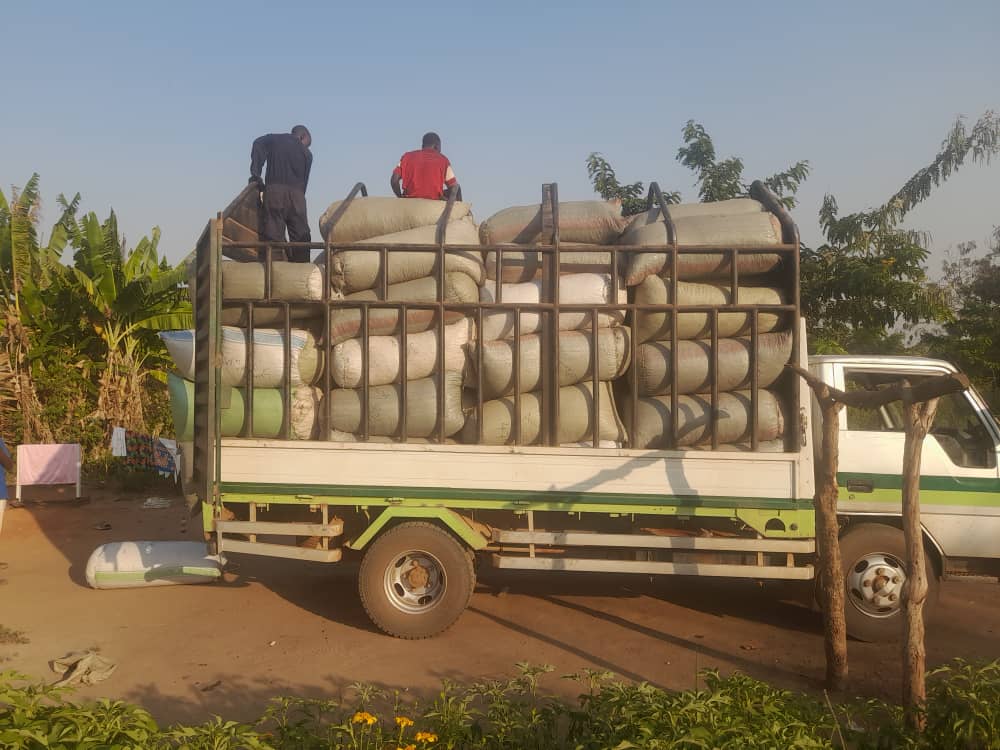
You can do everything right - quality seed, a tractor-prepared field, a clean harvest - and still lose much of the gain in the last step: the sale. Across Northern Uganda, the same crop that a farmer sells for a low price at the farm gate is sold again, days later, for far more by a middleman who did none of the growing. This guide explains why that happens and the practical ways farmers here lift the price they actually receive.
- Selling alone to roadside middlemen, right after harvest, is what keeps farm-gate prices low.
- Bulking, combining produce through a group, turns weak individual sellers into one strong one.
- Structured market linkages have earned farmers a ~15% premium, and in documented cases several times their previous price.
- Good storage lets you sell later, when prices rise, instead of in the post-harvest glut.
Why the farm gate pays so little
The low price a smallholder gets is not bad luck: it is the predictable result of how the market is structured against a lone seller.
You sell small, they buy big
A middleman buying from a hundred farmers has far more market power than any one farmer selling a few bags. Price is set by the stronger side.
You sell at the worst moment
Everyone harvests at once, so supply floods the market and prices fall. And that is exactly when families need cash for school fees and debts, forcing distress sales.
You sell blind
Without reliable price information, you take the buyer's word for "today's price." The information gap is itself a discount.
The fix: sell together, not alone
The single most powerful change a farmer can make is to stop selling alone. Bulking, aggregating many farmers’ produce into one large, quality-sorted lot through a group or cooperative, flips the power dynamic. Instead of a hundred weak sellers, the buyer faces one strong one, with volume, consistent quality and the ability to wait.
Selling alone
- Small volume, no bargaining power
- Sells in the post-harvest price slump
- Takes the middleman's quoted price
- No access to bigger buyers or processors
- Mixed quality fetches the lowest grade price
Selling through a cooperative
- Large, aggregated volume: real leverage
- Can store and sell when prices recover
- Negotiates contracts and off-take deals
- Reaches processors and institutional buyers
- Sorted, graded produce earns a premium
The evidence backs this up. Structured market linkages have earned farmers around a 15% premium over informal roadside rates, and in documented cases the difference is far larger. One cooperative of around a hundred farmers and several farmer groups in the region sold maize for roughly UGX 1,600 per kilo, more than three times what its members had been earning selling individually.
Why volume winsA buyer will pay more per kilo for one clean, graded, ten-tonne lot delivered to one place than for the same tonnage chased down in small bags across fifty villages. Bulking captures that difference, and returns it to the farmers.
Protect the crop so you can wait
Selling later, when the post-harvest glut clears and prices rise, is one of the simplest ways to earn more, but only if the crop survives storage. Poor drying and storage don’t just cause physical loss; in groundnuts and maize they breed aflatoxin, which shuts you out of the better-paying buyers entirely.
Dry properly and fast
Dry on a tarpaulin or rack, off the bare ground, to a safe moisture level. Mechanized drying through a hub speeds this up at scale.
Store clean and dry
Use clean, well-ventilated or hermetic storage. Good storage is what makes patient, higher-priced selling possible.
Grade and sort
Sorted, uniform produce commands a premium and opens contract and processor markets that mixed-quality grain can't reach.
Bridge the cash gap with credit, not distress sales
The reason farmers sell into the glut is usually a cash need that can’t wait: school fees, a debt, an emergency. This is where membership in a SACCO matters beyond loans for inputs: a small, savings-backed emergency or bridging loan can cover the immediate need so you don’t have to dump your harvest at the lowest price of the year. The loan costs less than the discount you’d take in a distress sale.
This is the whole logic of a cooperative that does mechanization, savings, credit and market linkage together: prepare the land on time, plant quality seed, harvest and handle it well, hold rather than dump, and sell together for a fair price, with credit smoothing the cash-flow gap in between.
Learn about the cooperative’s services, savings and loans, or read how to grow groundnuts for a better harvest.
- National Planning Authority: Transforming Smallholder Farming to Modern Agriculture in Uganda (distress sales, weak bargaining power), 2023.
- "Farmer Connect: Improving Farmers' Access to Produce Markets": ~15% premium from structured market linkages; cooperative maize sale at ~UGX 1,600/kg, >3× prior earnings; Village Agent Model in Northern Uganda, 2026.
- Journal of Agriculture and Food Research; Cogent Food & Agriculture: post-harvest losses and aflatoxin in groundnut and maize, Eastern and Northern Uganda, 2023.
- IFDC: cooperatives linking Ugandan smallholders to markets, 2025.
Frequently asked questions
-
Because most smallholders sell small quantities individually to roadside middlemen, right after harvest when prices are lowest and cash needs are highest. Weak bargaining power, poor market information and urgent cash needs force low-price distress sales.
-
By bulking, combining many farmers' produce into one large, quality-sorted lot, a cooperative negotiates from strength with bigger buyers and processors. Structured market linkages have earned farmers meaningful premiums over informal roadside rates, and in some documented cases far more.
-
Often, yes: prices usually rise in the months after harvest as supply tightens. But waiting only works if you can store the crop without losing it to pests, moisture or aflatoxin, and if you don't need the cash immediately. Good storage and a little credit make patient selling possible.